


Last Updated: November 8, 2026
Quick Summary
Proof of ownership in whisky cask investment is a chain of documents, not a single certificate. The contract of sale creates legal title, while a delivery order acknowledged by the bonded warehouse confirms the transfer, so the names and cask reference must match across every record before you pay.
- A seller-issued ownership certificate is useful evidence but does not prove clean legal title.
- Match the cask reference number across the contract, certificate, delivery order and warehouse records.
- Ask the bonded warehouse keeper directly to confirm the cask reference, location and owner of record.
- A delivery order issued by the seller but never acknowledged by the warehouse is not a transfer.
- Do not complete a purchase when documents conflict or are missing; get advice before money moves.
Can you prove your cask is really yours?GreatDrams guides buyers through cask brokerage, documentation and independent bottling.
Table of Contents
- What Proof of Ownership Really Means in Whisky Cask Investment
- The Contract of Sale and Legal Title
- Your Whisky Cask Ownership Certificate and What It Does Not Prove
- The Whisky Cask Delivery Order and Transfer of Ownership
- How to Verify Whisky Cask Ownership Step by Step
- Cask Identification, Warehouse Records and the Documentary Trail
- Whisky Cask Investment Red Flags to Walk Away From
- Ownership Changes, Inheritance and Insolvency
- Building a Cask Portfolio with GreatDrams
- Frequently Asked Questions
What Proof of Ownership Really Means in Whisky Cask Investment
Here is the uncomfortable truth about whisky cask investment: proof of ownership is not a certificate. It is a chain of documents that has to line up, and most buyers only discover the weak link when they try to sell. At GreatDrams, we have watched this play out often enough to know that the paperwork matters more than the pitch.
The Scotch Whisky Association is direct on this point. A Scotch Whisky Association guide to personal investment in a Scotch whisky cask states that the contract of sale represents legal title and proof of purchase, which is a very different thing from the glossy certificate many sellers hand over. That distinction sits at the heart of every sound cask purchase.
Title, possession and beneficial ownership: the distinction that matters
Three separate ideas get muddled together constantly.
Legal title is ownership in law, and it flows from the contract of sale. Possession is who physically holds the cask, almost always the bonded warehouse. Beneficial ownership is who actually benefits from the cask financially. You can hold a certificate and still lack clean title, which is why the document trail beats the document.
The Contract of Sale and Legal Title
The contract of sale is the single most important document in any cask purchase. It should name the buyer and the seller precisely, identify the individual cask, state the spirit type, cask type, cask size, fill date and distillation date, and set out what happens on resale.
A reported mismatch between the paying company and the entity named in ownership documents featured in the Brodies analysis of the Cask Spirits Global winding up, and it is the clearest warning we can offer: if the name on the invoice, the contract and the title documents do not match, stop and ask why.
Your Whisky Cask Ownership Certificate and What It Does Not Prove
A whisky cask ownership certificate is a seller-issued record confirming that a named buyer holds an interest in a described cask. It is useful evidence. It is not, on its own, proof of legal title.
DLA Piper’s guide to the Scotch whisky regulatory framework notes that sellers may provide a certificate of ownership, while legal title is better evidenced through the underlying sale contract. Treat the certificate as one link in the chain, never the whole chain.
The Whisky Cask Delivery Order and Transfer of Ownership
A whisky cask delivery order is the instruction that moves a cask from one holder to another within a bonded warehouse. It is the practical mechanism of transfer, and it is where possession and ownership finally meet.
The document should identify the cask reference number, the warehouse, the warehouse keeper, the transferring party and the receiving party. Without a delivery order acknowledged by the warehouse, a buyer may own something in theory while the warehouse records still name someone else. That gap is exactly where disputes begin.
How to Verify Whisky Cask Ownership Step by Step
Knowing how to verify whisky cask ownership comes down to one principle: confirm the buyer, the individual cask and the warehouse records independently, rather than accepting a single document at face value. A seller-issued certificate is a claim. A warehouse confirmation is evidence. The gap between those two things is where most cask disputes live.
Work through it in this order, and do not skip a step because the seller seems reputable. Reputation is not a document.
- Check the contract of sale names the correct legal entities on both sides, including company numbers where the buyer or seller is a business.
- Match the cask reference number across the contract, the certificate, the delivery order and the warehouse records. One digit out and you are looking at a different cask.
- Confirm the cask description: distillery, spirit type, cask type, cask size, fill date and distillation date. These should be identical everywhere they appear.
- Obtain a delivery order acknowledged by the warehouse keeper, not merely issued by the seller.
- Ask the bonded warehouse directly to confirm the cask reference, its location and the registered owner of record.
- Confirm storage charges and insurance responsibilities in writing, and check whose name sits on the storage account.
- Keep every document, including proof of purchase and prior transfer records, in one file you could hand to a future buyer.
Independent confirmation from the bonded warehouse
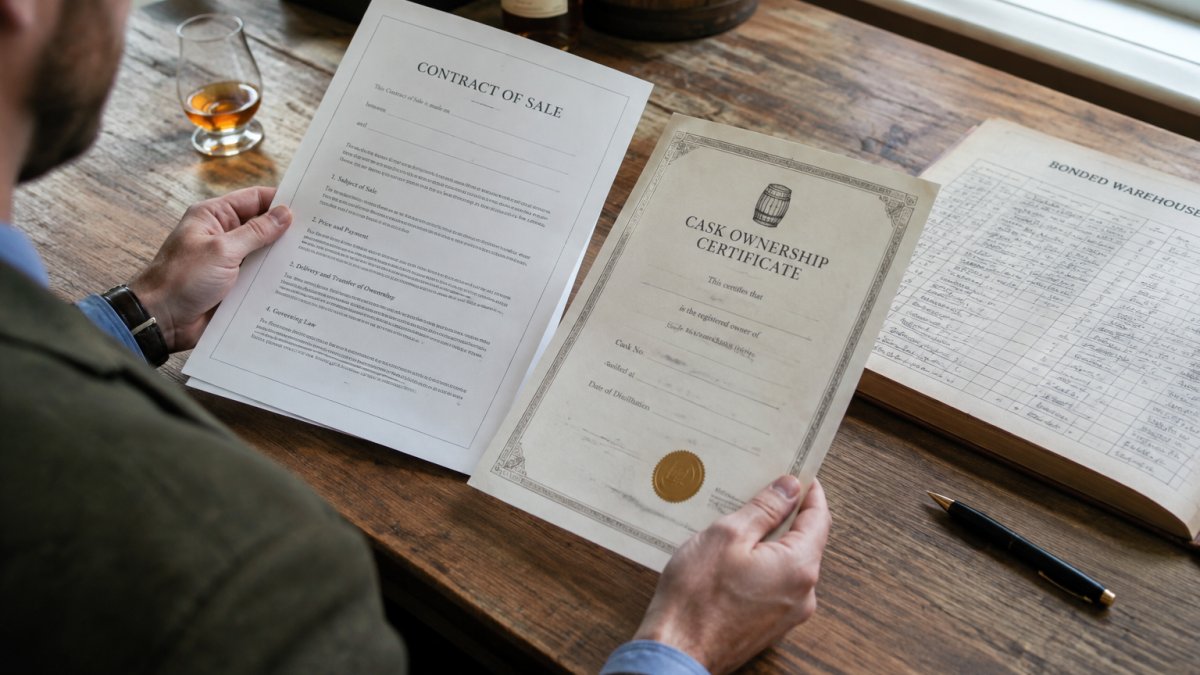
This is the step buyers most often fudge, and it is the one that matters most. Write to the warehouse keeper directly, using contact details you have sourced independently rather than ones supplied by the seller, and ask for written confirmation of four things: the cask reference, its physical location within the warehouse, the owner of record, and the current status of the cask. A short email reply covering those four points closes more gaps than any certificate.
Watch out: if a seller resists that request, or insists on handling the warehouse correspondence themselves, treat the resistance as the answer and pause the purchase.
A worked example of a clean chain
Picture a straightforward purchase. A seller, a company, agrees to sell a single hogshead to a private buyer. The contract of sale names the seller company and the buyer, quotes the cask reference, and states the distillery, fill date and cask type. The seller issues a delivery order instructing the warehouse keeper to transfer the cask from the seller’s account to the buyer’s account. The warehouse keeper acknowledges the instruction in writing and confirms the cask reference, location and new owner of record. The buyer receives an invoice, a receipt and the warehouse confirmation, and files all of it together.
Now picture the same purchase where the invoice is issued by a different company from the one named in the contract, the cask reference on the certificate has an extra digit, and the warehouse has never heard of the buyer. Each of those is fixable before money moves and deeply expensive afterwards. The point of the exercise is to make the names, the cask reference and the warehouse records agree before completion, not after.
What to do when documents conflict or are missing
Do not complete the purchase. Ask for the missing link in writing, keep a dated record of the request, and take advice before money moves. A missing delivery order or a name mismatch is fixable before completion and very expensive afterwards. If the seller cannot produce a warehouse acknowledgement, ask the warehouse directly whether the cask exists and who is registered as its owner. If the answers do not line up, walk away and preserve every email and document you have received.
| Document | What it proves | What it does not prove |
|---|---|---|
| Contract of sale | Legal title and proof of purchase | That the warehouse holds the cask |
| Ownership certificate | Seller’s record of your interest | Clean legal title |
| Delivery order | Transfer within the warehouse | That the cask exists as described |
| Warehouse records | Physical custody and location | Who benefits financially |
| Proof of purchase | Payment trail | Chain of title |
Cask Identification, Warehouse Records and the Documentary Trail
Cask identification is where most due diligence succeeds or fails. Every cask carries a reference number, and that number must appear identically on the contract, the certificate, the delivery order and the warehouse records. One digit out and you are looking at a different cask. It sounds pedantic until you have seen two casks from the same distillery, filled on the same day, with references that differ by a single character.
A complete documentary trail should run unbroken from distillation through every transfer of ownership to you. In practice that means four layers of evidence, and each one answers a different question.
The commercial layer. The contract of sale and the invoice establish who agreed to buy what from whom, and on what terms. This is where legal title is created.
The cask layer. The cask certificate or cask record establishes the physical facts: distillery, spirit type, cask type, cask size, fill date and distillation date. These details should match the contract exactly.
The warehouse layer. The delivery order and the warehouse keeper’s acknowledgement establish that the cask is physically held, where it is held, and who is registered as its owner. This is the layer that turns a contractual right into something you can point at.
The payment layer. Proof of purchase, bank records and receipts establish that money changed hands and when. Future buyers will ask for this, and so will anyone investigating a dispute.
Understanding how independent bottlers buy, hold and document casks helps here, and our guide to how independent bottlers work explains the route from distillery to warehouse in plain terms. The principle is the same whether you are buying one cask or twenty: the paperwork has to connect the buyer, the individual cask and the warehouse records, and it has to do so without gaps.
Watch out: a common pattern is a chain that looks complete until you notice the delivery order was issued by the seller but never acknowledged by the warehouse. That is not a transfer. It is an instruction that may never have been actioned.
When the trail breaks
Chains break in predictable places. A cask is sold privately and the delivery order is never lodged with the warehouse. A company changes name and the warehouse records still show the old entity. A cask is inherited and the transfer is never documented. An intermediate seller goes into liquidation and the paperwork goes with it.
If you find a break, do not paper over it. Ask the warehouse keeper what they hold on record, ask the seller for the missing link in writing, and take professional advice before you pay or attempt a resale. A broken chain is not automatically fatal, but it has to be repaired with evidence rather than reassurance. The buyer who inherits a gap inherits the problem, and the time to fix it is before completion, not when you are trying to sell.
Whisky Cask Investment Red Flags to Walk Away From
Whisky cask investment red flags tend to cluster around pressure and paperwork. Guaranteed returns, rushed deadlines, a seller who will not name the warehouse, a certificate offered in place of a contract, or an entity name that shifts between documents are all reasons to pause.
Our piece on what makes a limited edition worth collecting covers the judgment side of the same question. If a release or a cask cannot be explained clearly, it usually cannot be verified clearly either.
Ownership Changes, Inheritance and Insolvency
Ownership does not stand still. A cask can be sold, gifted, inherited or caught up in a company insolvency, and each of those events needs a documented transfer. If the chain of title breaks at any point, the current holder inherits the problem.
Keep your own records as carefully as you would a property deed: contract, delivery orders, warehouse confirmations, storage invoices and insurance details. Future buyers will ask for exactly that file.
Building a Cask Portfolio with GreatDrams
A cask portfolio is only as strong as the paperwork underneath it. We have written before about the parallels between rare casks and other collectibles, and the same rule applies: provenance and documentation drive value as much as the liquid does.
GreatDrams is an award-winning independent bottler and cask brokerage, and our approach is to make the complex accessible rather than mysterious. If you want to know who we are and how we work, that story is worth reading before you commit to anything. The same care we bring to our own limited edition whisky releases, where every bottle is documented from cask to customer, is the standard we would encourage you to demand of any cask purchase.
The real test of any cask purchase is simple: could a stranger reconstruct your ownership from the documents alone? If not, the file needs work before the money moves. GreatDrams offers cask brokerage, single cask bottlings and independent guidance built on exactly that standard, so you can buy with the paperwork as sound as the whisky. Get started with GreatDrams and build a cask portfolio you can actually prove.
Frequently Asked Questions
What documents prove ownership of a whisky cask?
The contract of sale is the core document. The contract of sale is where legal title and proof of purchase are usually evidenced. A whisky cask ownership certificate, delivery order and warehouse records support that contract but do not replace it. Ask for the full set, check that the seller named on the contract matches the entity on the certificate, and confirm the cask reference with the bonded warehouse directly.
Is a delivery order proof of whisky cask ownership?
Not on its own. A whisky cask delivery order instructs the warehouse keeper to release or transfer the cask, so it shows an intention to move custody, not who holds title. Treat it as one link in the chain of title. The contract of sale establishes ownership; the delivery order and warehouse acknowledgement show the cask is real and held where the seller says it is.
How can I verify that a whisky cask exists?
Ask the bonded warehouse keeper, not the seller, to confirm the cask reference number, distillery, spirit type, cask type, cask size, fill date and current location. Warehouse records are independent of the sales process. If the keeper will not confirm the cask is held under your seller’s account, or the details do not match the paperwork, pause before paying anything further.
What should I do if the seller cannot provide proof of cask ownership?
Do not complete the purchase. Request the contract of sale, the ownership certificate and the warehouse confirmation in writing. If documents are missing or name a different entity, walk away until the chain of title is clear. A certificate alone is not enough, and a seller who cannot produce the underlying contract has not demonstrated clear title.
Who should hold the warehouse records for a whisky cask?
The bonded warehouse keeper holds the operational records: cask reference number, fill date, distillery, cask type and storage charges. You should be able to request confirmation from the keeper that the cask is held and, after transfer, that ownership records have been updated. Keep your own copy of every document, including delivery orders and regauge reports, so your documentary trail does not depend on the seller.
What are the main whisky cask investment red flags?
Documents naming a different company from the one you paid, a certificate offered without a contract of sale, refusal to let you contact the bonded warehouse, pressure to pay quickly, and no clear answer on storage charges or insurance. Any mismatch in the chain of title is a reason to stop.







-

GreatDrams Whisky Pouch 50ml Multiple Options Available
Price range: £8.00 through £20.00