Today, I’m going to be talking to you about a topic that I find fascinating. Also, because of what we do here at Great Drams, it’s a topic that’s particularly apt. Yes, I’m talking about whisky distillation. Specifically, I’m going to talk about the equipment used in whisky distillation.
Distillation is basically a process whereby alcohol found in a fermented liquid is removed, concentrated, and separated. It’s basically the final step before whisky is barrelled and aged for at least 3 years.
Without getting too technical or scientific on you, distillation occurs when a liquid is heated, before its vapours are cooled and condensed down into alcohol. In order for distillation to take place, the correct equipment is needed. Without question, the most important piece of kit during this process is a device called a ‘still’ and it is this very device that we’ll be looking at today.
While whisky stills come in different shapes and sizes, the two most common types are pot stills and column stills. Here’s a look at what they are, and how they differ.
What Are Stills and How Do They Work?
Despite distillation being a complex and arduous process, the role of a still in said process is actually very simple. Basically, it acts as a giant kettle or heating vessel which heats a liquid containing low levels of alcohol, such as beer or cider.
Typically, there are two different types of still used in the distillation process, and these are:
-
- Pot stills
-
- Column stills
Though they serve the same function, they do feature different designs and subsequently, they will produce different tasting drams. I’ll be looking at how they differ from one another next. Before that, though, let’s get back to today’s basic chemistry lesson.
Once heated inside the still, alcoholic compounds in the liquid will evaporate at a much lower temperature than water and are converted into gas. This separates them from the alcohol-free compounds.
Next is where the fun really starts. As these vapours rise up through the still, the gases cool down and are converted back into a liquid. This liquid, however, is now much higher in alcohol. It is essentially now an alcoholic spirit and forms the basis of our beloved whisky.
There are more steps involved, but it is this liquid which eventually becomes whisky after being barrelled and aged for at least 3 years.
What are Pot Stills?
In whisky production, pot stills are steeped in history and tradition, and rightly so. They’ve been around for more than four centuries and are still used to this day.
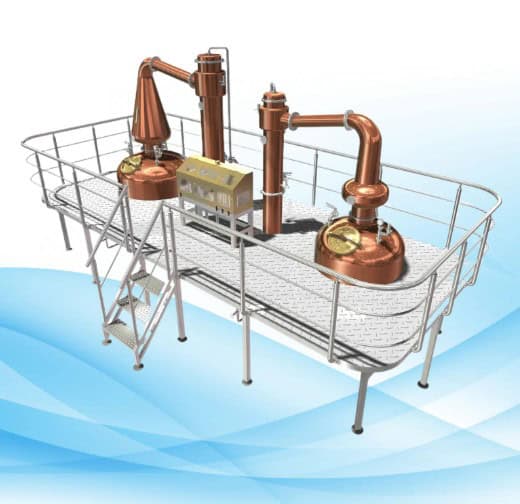
So, what exactly are pot stills? Well, as the name implies, they are large vessels, usually made of copper which are heated from the bottom and feature a wide base located at the bottom of the vessel, that tapers vertically into a much narrower neck. This tapered design allows the vapours to cool as they rise, thereby allowing them to be converted into a liquid. Think of the shape of an onion, and you’re definitely in the right ballpark.
Pot stills vary in size and design, and even allow vapours to undergo further processing via a selection of rectifying plates or columns mounted on the sides. This results in a spirit which has a much higher ABV%.
With Scotch, the distillate liquid is often distilled twice before the liquid can be transferred to casks. Irish whiskey, however, has a reputation for being triple distilled in pot stills to help impart an even smoother finish with fewer harsh ethanol notes. Most Irish whiskey is distilled in copper pot stills, though there are some that are distilled in column stills, with fantastic results.
Despite what some may believe, not all Irish whiskey is triple-distilled, just like not all Scotch is distilled twice. There are plenty of amazing single malt Scotch whiskies out there which have been distilled three times, with Auchentoshan and Benriach triple-distilled both being prime examples.
As beneficial and traditional as pot stills are, they’re not always the most economic choice, especially for larger distilleries producing millions of litres of spirit each year. This is because they can only produce one batch at a time.
What are Column Stills?
Up next, we have a newer innovation in the world of whisky production, despite being nearly two centuries old.
Column stills, also known as continuous stills, patent stills, or Coffey stills are considered by many to be more economical, despite featuring a much more complex design. They were designed in the early 1830s by an Irishman by the name of Aeneas Coffey in a bid to speed up whiskey production.
Column stills, unlike pot stills, are continuous which means they can be running constantly and can be used to produce batch after batch after batch. They are also now much more sophisticated and are often computerised and can be controlled and regulated with various gadgets and gizmos.
Column stills generally feature one tall cylindrical column, which inside, features a series of vertically stacked plates which separate the inside of the still into different compartments. Just like with pot stills, they are heated from below via steam, which causes the whisky wash to evaporate and rise up through the still. As it rises, vapours condense around the plates located inside, which removes water and other unwanted compounds from the alcoholic vapour. This process is known in the biz as ‘reflux’. Once the vapours reach the top of the still, they are condensed into spirit.
Column stills can operate 24/7, so distillers can continuously produce batches of spirit. They produce spirit that is often smoother and slightly lower in alcohol than pot stills. While pot stills are more common here in the UK, column stills are preferred in America. Most bourbons are produced via column stills, along with some of the smoother ryes out there.
Even though column stills generally produce lighter, smoother, mellower spirits that does not mean that they are incapable of producing full-bodied, higher ABV, more complex spirits. While purists may prefer pot still whisky, there are still heaps of exceptional drams out there distilled via column stills.
If you’d like to learn more about your favourite whiskies, or simply treat yourself to a dram or two in the process, head on over to GreatDrams.com and check out the diverse selection of unique whiskies we currently have in stock.
With an impressive selection of limited-edition, rare, and award-winning whisky, as well as heaps of whisky info on our blog, it’s the perfect spot for any whisky lovers out there.